


An AMI router can remain registered on a cellular network while its data session or VPN tunnel fails. For utilities, this is more than a connectivity issue: the right supplier must support hardware selection, application testing, customization, and repeatable deployment.

Tespro is an industrial router manufacturer developing cellular connectivity equipment for smart grid, metering, and industrial IoT applications. Here is what utility engineers and OEM buyers should evaluate before ordering.
1. Why Source AMI Routers Directly from Tespro?
Tespro performs hardware and software R&D, manufacturing and assembly in Zhuhai, China. The engineering teams develop communication interfaces and firmware. Published manufacturing processes describe quality control and testing of each unit prior to shipping. Technical support and R&D work collaboratively to fulfill project requirements.
These features are important for buyers when the standard router requires modification to be integrated with a DCU, metering cabinet or UMS. They also serve to discuss consistency of configuration between prototypes and production orders.
However, factory testing is not a substitute for application-specific acceptance testing. Ask Tespro to identify the tests, records, and firmware versions applicable to your order.
2. What Kinds Of OEM/ODM Customization Are Available?
As part of its OEM/ODM support, Tespro can integrate customer branding and specific hardware, interface and software requirements. The Tespro TR-445 series document describes integrating modular I/Os, custom branded firmware and web interfaces, and SDKs and other resources for remote configuration.
In general, the work scope of an AMI customization should include:
•Hardware: definition of RS-485/RS-232/Ethernet ports and power input, placement of antennas and enclosure mounting;
•Software: definition of carrier settings, VPN policies, protocols, user permissions, firmware branding and integration with existing management tools;
•Production: approved samples, configuration baseline, change control, labels, documents and acceptance criteria.
It should be understood that the agreed customization scope and feasibility should be defined against a specific model and purchase order specification and not derived from product family assumptions.
3. Where Does an Industrial Router Fit in AMI?
A common network path is:
Smart meters → RF mesh/PLC → DCU → Cellular Router → Head-end System (HES) → Meter Data Management System (MDMS).
The router provides IP backhaul between a concentrator and the utility network. Other AMI architectures connect meters directly over cellular or use gateways with integrated routing.
Confirm which device is responsible for protocol conversion, meter-data buffering, and retransmission. Transparent TCP/UDP forwarding does not automatically mean the router stores readings during an outage.
4. Which Tespro Router Features Matter?
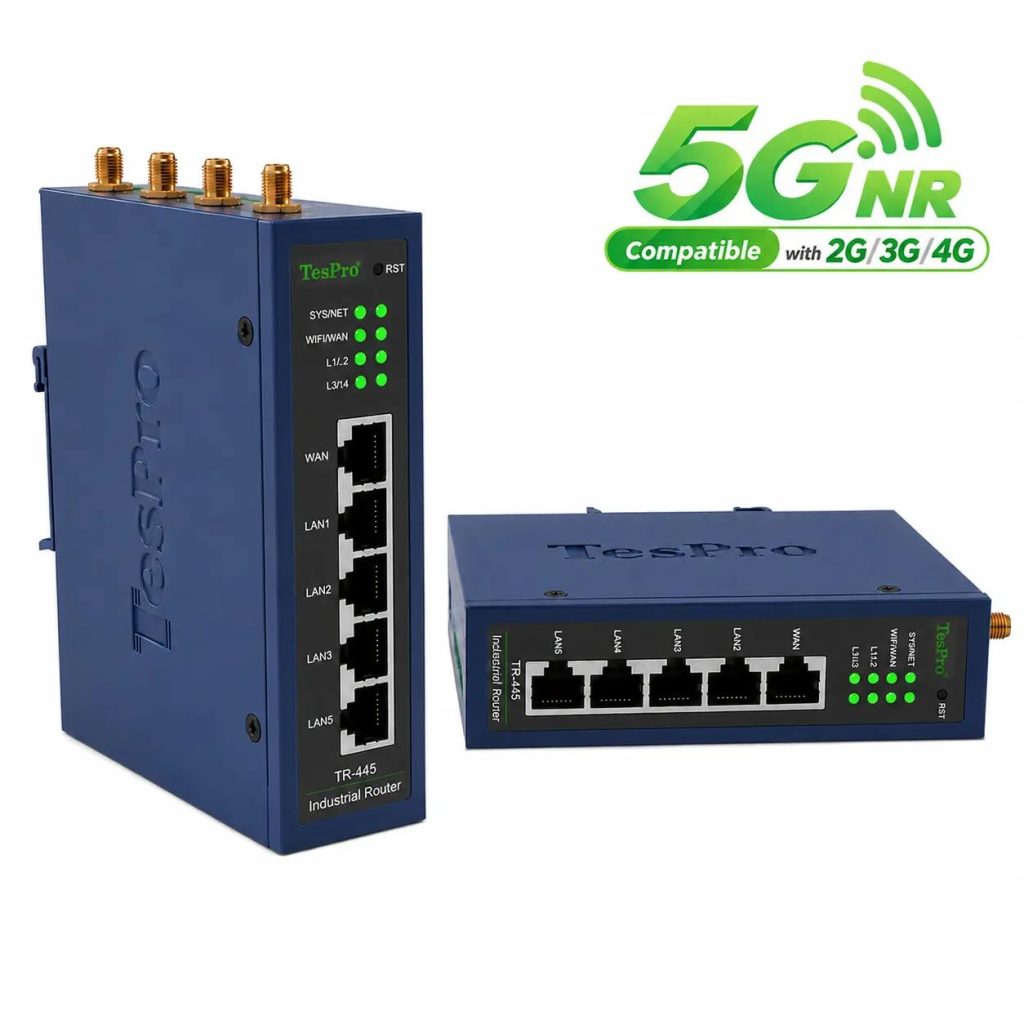
The Tespro TR-445 industrial cellular router provides a useful reference for specification discussions:
| Feature | TR-445 specification | Buyer verification |
| Cellular connectivity | 4G/5G options; dual SIM/eSIM configurations | Carrier bands and tested failover |
| Ethernet | 1 Gigabit WAN + 4 Gigabit LAN | DCU connections and network segmentation |
| Serial and I/O | 2 RS-485, 1 RS-232, 4 configurable I/O | Wiring, isolation and protocol behavior |
| Meter protocols | DLMS, IEC 62056-21, DL/T 645-2007 listed | Exact meter profiles and commands |
| Operating environment | 12–36 V DC, −40°C to +75°C, IP30 | Cabinet protection and electrical conditions |
| Management | VPN functions, link detection, firmware management | Security policies and recovery procedures |
These specifications apply to the TR-445, not every Tespro router. Listed protocol support does not guarantee interoperability with every meter; DLMS security settings, object models, and communication profiles must be tested with actual equipment.
5. Is 4G Enough for a Smart Grid Deployment?
4G is often sufficient for routine scheduled meter readings. For other cases, consider 5G. Other factors such as the availability of the network, performance of the antenna, and latency of the network become more important than the maximum speed of the network.
In such cases, measure RSRP, RSRQ, and SINR at the location of interest. Also, consider the effect of VPN, reporting bursts, coverage of the cellular network, loss of an external antenna cable, and surge protection in the design.
6. How Should Quality and Failover Be Verified?
A dual-SIM router does not automatically restore application sessions when it switches cellular carriers. An invalidated HES connection and VPN, due to a change of IP address, would require reconnection.
Prior to bulk purchasing, perform tests with actual DCU, meters, SIMs and HES. Document the following:
•Interoperability: Head-End System commands, authentication of meters, and end-to-end Head-End System acknowledgements
•Recovery: Time to reconnect VPN, link loss detection, and repeated outages
•Data Integrity: Records that remain unacknowledged, DCU retransmits data upon reconnection to the service
•Environments: Consider supply disturbances, temperature, grounding and cabinet conditions
•Remote Operations: Think of access controls, firmware updates, retention of configuration, logs.
Restoration of the network does not recover data in the DCU and other utility systems.
7. What Should Procurement Confirm Before Ordering?
A datasheet of the relevant model, the latest firmware, supporting compliance documents, evaluation plan sample, factory inspection scope and support arrangements. Agree on the terms of deliverables for customization, MOQ, production lead time, schedule and shipping. Also agree on how firmware and/or components will change across batches.
Tespro's OEM/ODM and contract manufacturing capabilities are preliminary, project level validation and terms are agreed upon purchase order.
Discuss your AMI router needs with Tespro.
State your DCU and meter interface, operating region, cellular carriers, security requirements, quantities expected and deployment region. Tespro will provide feedback and consider your OEM/ODM needs.
Request a quote for a Tespro industrial router..
FAQs
Q1. Does the Tespro TR-445 support DLMS and smart meter protocols?
The TR-445 lists DLMS, IEC 62056-21, and DL/T 645-2007 among its supported protocols. Actual meter interoperability and protocol conversion functions should be verified using the target meter models and software configuration.
Q2. Does Tespro offer OEM/ODM industrial router services?
Yes. Tespro provides OEM/ODM services, including hardware customization, interface configuration, firmware development, and product branding. Customization options depend on the selected router model and project requirements.
Q3. Where are Tespro industrial routers manufactured?
Tespro manufactures and assembles its industrial connectivity devices in Zhuhai, China. Its in-house engineering and production capabilities support product development, customization, quality control, and manufacturing.
Q4. Which Tespro industrial router is suitable for AMI systems?
The Tespro TR-445 is an option for AMI cellular backhaul applications. It provides 4G/5G connectivity, Gigabit Ethernet, RS-232/RS-485 interfaces, and industrial communication features. Final suitability depends on DCU compatibility and project testing.
Q5. Do Tespro industrial routers support 4G and 5G networks?
Yes. Tespro offers industrial cellular routers with 4G LTE and 5G connectivity options. Supported frequency bands and cellular features vary by model and configuration, so carrier compatibility should be verified before ordering.


