


Industrieller Mobilfunkrouter
Product ID: TR-444
Unabhängig entwickelt von Tespro, unterstützt der TR-444-Industrierouter globale 2G/3G/4G-Netzwerke, Gigabit-Ethernet (1*WAN 2*LAN) und Dual-Band-Wi-Fi 4/6. Ausgestattet mit 1*RS232-, 2*RS485- und 4*GPIO-Schnittstellen sowie Modbus/BACnet-Unterstützung, gewährleistet er zuverlässige Konnektivität für IoT- und Industrieautomation.
-
Netzwerk
2G / 3G / 4G
-
Schnittstelle
1*WAN 4*LAN 10 / 100 / 1000 Mbit/s
-
WLAN
Wi-Fi 4 (802.11b/g/n) / Wi-Fi 6 (802.11a/b/g/n/ac/ax)
-
Seriell & I/O
1*RS232 2*RS485 4*GPIO
Jetzt kostenloses Angebot erhalten
Download

TR-344 Industrierouter Video
Der TR-444 Industrial LTE Router zeigt zuverlässige 4G/LTE-Konnektivität, industrielle Haltbarkeit, sichere Netzwerke und zuverlässige Fernkonnektivität zur Automatisierung intelligenter IoT-Geräte und Feldeinsätze.
Features
Kernvorteile

4G/3G/2G & Dual SIM/eSIM
Unterstützt vielfältigen Mobilfunknetzzugang (2G/3G/4G/5G) mit 4G LTE-Optionen einschließlich Cat1/Cat4/Cat6. Ausgestattet mit Dual-SIM- und Dual-eSIM-Funktionen für flexible Schaltvorgänge und Link-Backup.

Gigabit-Ethernet-Schnittstelle & Wi-Fi
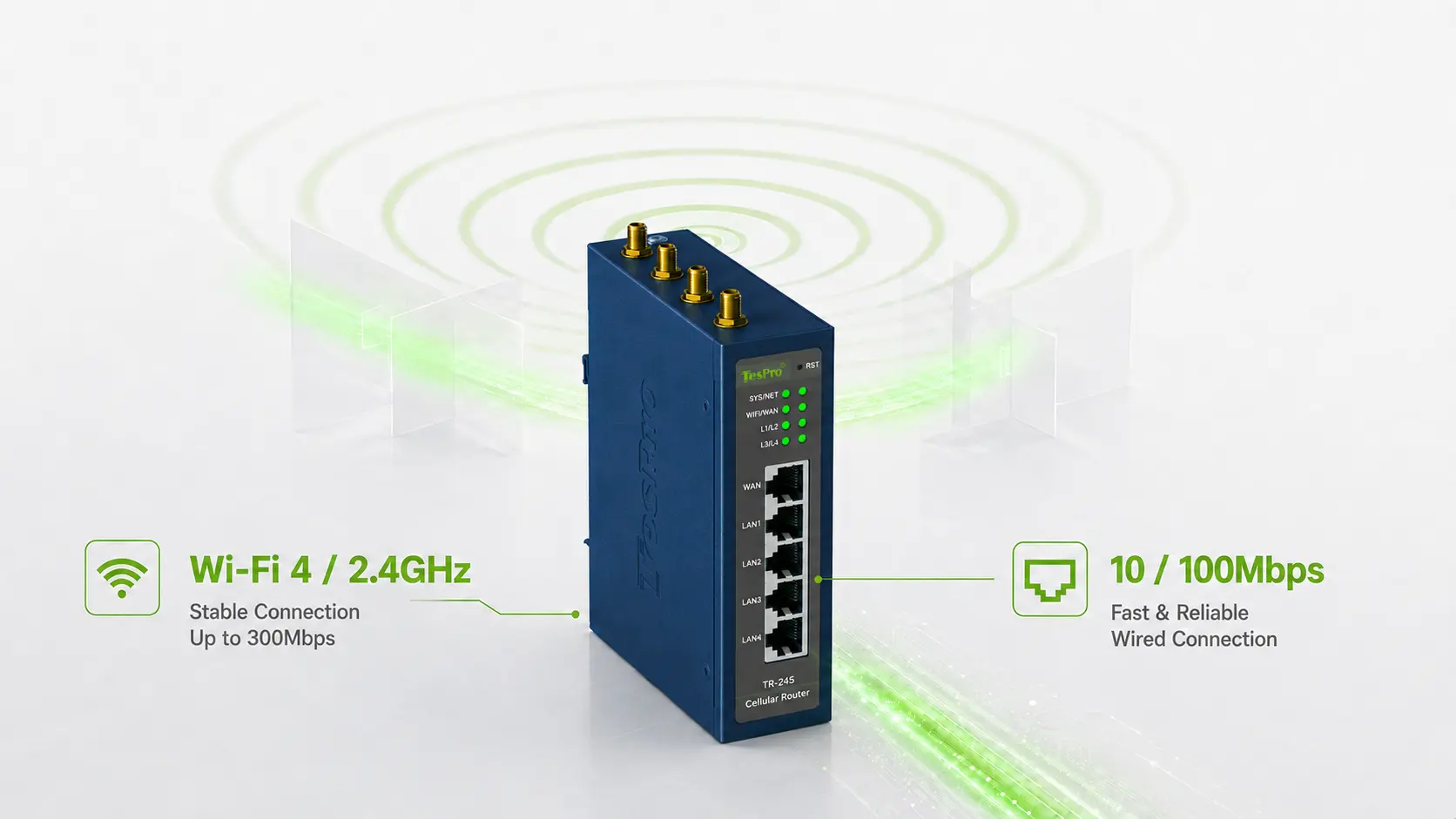
Ausgestattet mit Gigabit-Ethernet-Anschlüssen, die WAN/LAN-Autosensierung unterstützen, und mit Dual-Band-Wi-Fi 4 (2,4 GHz) und Wi-Fi 6 (5 GHz) Funktionen, kombiniert es Hochgeschwindigkeits-kabelgebundene Übertragung mit bequemem drahtlosem Zugang, um die Anforderungen von Industrieausrüstung, Datenübertragung und Vor-Ort-Netzwerken zu erfüllen.

Integrierte serielle und GPIO-Schnittstellen
Ein integriertes Design mit seriellen Anschlüssen (1*RS232, 2*RS485) und 4*GPIO-Schnittstellen erleichtert die Verbindung von Industriegeräten und ermöglicht die Steuerung digitaler (Ein/Aus-)Ein- und Ausgänge.

TesproOS-System & Remote O&M
Ausgestattet mit dem proprietären TesproOS-Betriebssystem und einem visuellen, webbasierten Management-Dashboard ermöglicht es eine vollständige Geräteverwaltung im gesamten Lebenszyklus. Es unterstützt Echtzeit-Cluster-Statusüberwachung, Remote-Batch-Parameterkonfiguration, Log-Diagnostik und cloudbasierte OTA-Firmware-Updates; in Kombination mit mehrschichtiger VPN-Verschlüsselung ermöglicht es effiziente O&M-Operationen ohne Besuche vor Ort.

Rich-Protokoll-Ökosystem
Es integriert nordgehende Cloud-Konnektivität (MQTT/OPC UA), industrielle Feldbusse (Modbus/ProfiNet) und branchenspezifische Protokolle für Strom- und Energiespeicherung (DLT645/IEC61850). In Kombination mit robuster OpenVPN/IPSec-Verschlüsselung und schneller Entwicklung maßgeschneiderter Protokolle vereinfacht es den Geräte-Onboarding-Prozess – ermöglicht Plug-and-Play-Funktionalität – und beschleunigt die Konvergenz von OT- und IT-Daten.

Ausgezeichnete Wetterbeständigkeit
Mit einem breiten Betriebstemperaturbereich von -40°C bis 75°C und einer nicht kondensierenden Luftfeuchtigkeit von 5 % bis 95 % RH sowie einer IP30-Schutzklasse bewältigt sie zuverlässig komplexe und raue Industrieumgebungen – einschließlich großer Höhen, hohe Temperaturen und hohe Drucke – und gewährleistet so einen stabilen Betrieb der Geräte.
Tech Specs
Industrie-Fräs-Spezifikationstabelle
Hardware-Spezifikationen
| Kategorie | TR-444 |
| HardwareSystem | |
| CPU | Dual-Core-Cortex-A53-Prozessor, mit 1,3 GHz getaktet |
| RAM | 512 MB, DDR3 |
| Flash | 256 MB |
| Netzwerkschnittstellen | |
| Ethernet-Ports | 5 x 10 / 100 / 1000 Mbps |
| Mobilfunknetz | 4G LTE:Cat1 / Cat4 / Cat6;5G NR: eMBB/RedCap |
| WAN | 1 x WAN 10 / 100 / 1000 Mbit/s |
| LAN | 4 x LAN 10 / 100 / 1000 Mbps |
| SIM-Slot | Dual SIM / Dual eSIM / 1× SIM 1× eSIM |
| Antenne | SMA-Männchen (Außengewinde, inneres Loch); Antennenanschlüsse: 4 Stück |
| Physikalische Schnittstellen | |
| Erdungsterminal | 1 × Erdungsschraube |
| Statusindikatoren | 6 Teile |
| Reset-Knopf | 1 Stück |
| Industrielle Schnittstellen | |
| Serielle Anschlüsse | 2 x RS485 1 x RS232, 3 kV Hochspannungsisolierung |
| I/O-Schnittstellen | Unterstützt 4 × I/O; DI/DO-konfigurierbar |
| WLAN-WLAN / WLAN | |
| WLAN-Frequenz | 2,4 GHz, 5 GHz |
| Protokollstandards | Wi-Fi 4: 802.11b/g/n; Wi-Fi 6: 802.11a/b/g/n/ac/ax |
| Maximale Übertragungsrate | AX3000 |
| Datenrate | 802.11b/g/n: bis zu 574 Mbit/s; 802.11a/b/g/n/ac/ax: bis zu 2402 Mbit/s |
| Sendeleistung | 802.11b: 16dBm ±2dBm (11 Mbit/s); 802.11g: 16 dBm ±2 dBm (54 Mbit/s); 802.11n@2,4 GHz: 16 dBm ±2 dBm (HT20 MCS7); 802.11n@2,4 GHz: 16 dBm ±2 dBm (HT40 MCS7) |
| Übertragungsentfernung | Sichtlinie ≤ 100 Meter (tatsächliche Entfernung hängt von der Umgebung vor Ort ab) |
| Stromversorgung | |
| Stromschnittstelle | DC-Stromschnittstelle: 1 (DC2.1) |
| Eingangsspannungsbereich | Gleichstromversorgung: 12–36V; unterstützt Schutz gegen umgekehrte Polarität |
| PoE (Optional) | Unterstützt PoE-Netzteile; kompatibel mit IEEE 802.3af / IEEE 802.3at (PoE) Standards |
| Standby-Strom | 120mA–200mA @12V |
| Betriebsleistung | 150mA–320mA @12V |
| Spitzenleistung | 320mA @12V |
| Umweltbedingungen | |
| Betriebstemperatur | -40°C bis 75°C |
| Betriebsfeuchtigkeit | 5 % bis 95 % (nicht kondensierend) |
| Speichertemperatur | -40°C bis 80°C |
| Mechanische Spezifikationen | |
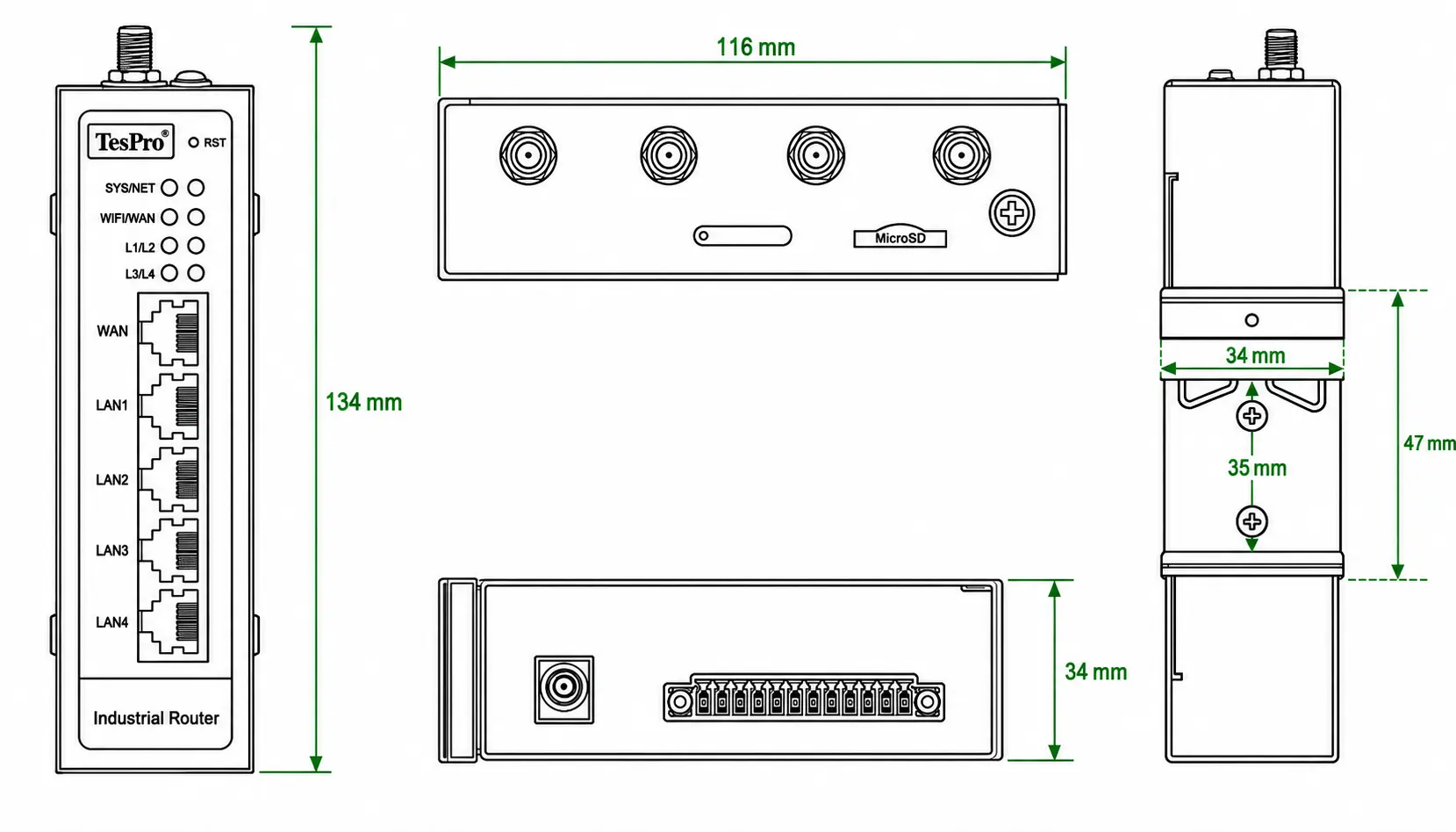
| Produktmaße | 116 × 134 × 34 mm (einschließlich Antennenstecker) |
| Schutzbewertung | IP30 |
| Wohnraum | Metallgehäuse |
| Montagemethode | DIN-Schienen / Wandmontage |
| Kühlmethode | Lüfterlose Kühlung |
| Produktgewicht | 450 g |
| Zuverlässigkeit | |
| Schock | IEC60068-2-27 |
| Vibration | IEC60068-2-6 |
| Fallen | IEC60068-2-32 |
| Zertifizierungen und Standards | |
| Regulatorische Zertifizierung | CE, RoHS |
| EMC-Standards | EN 55032; EN 55035; EN IEC 61000-6-3:2021; EN IEC 61000-6-1:2019; EN 301489-1; EN 301489-17; EN 301 489-52 |
| RF-Standards | EN300328; EN301893; EN301511; EN301908-1/-2/-13 |
| SAR-Sicherheit | EN50665; IN IEC62368-1 |
| Cyber | EN18031-1; EN18031-2 |
| ESD (Elektrostatische Entladung) | EN 61000-4-2:2009 |
| Strahlenimmunität | EN IEC 61000-4-3:2020 |
| Burst (EFT) | EN 61000-4-4:2012 |
| Surge | EN 61000-4-5:2014 A1:2017 (Ethernet-Ports) |
| Durchgeführte Immunität | EN 61000-4-6:2014 |
| Oszillatorische Wellenimmunität | EN61000-4-12, Stufe 3 |
| Magnetfeldimmunität | EN61000-4-8, horizontal/vertikal 400A/m (>Level 2) |
Software-Spezifikationen
| Kategorie | TR-444 |
| Industrielle Protokolle und Datenfähigkeiten | |
| Industrielle Protokolle | Beinhaltet Modbus RTU, Modbus TCP, BACnet, Mbus, OPC UA und verschiedene andere Protokolle |
| Modbus | Modbus RTU, Modbus TCP |
| Industrielle Geräteprotokolle | ProfiNet, EtherCat, EtherNet (optional) |
| BACnet | BACnet |
| OPC UA | OPC UA |
| Stromzählerprotokolle | DLT 645-2007, IEC 1107, IEC 61850, IEC 62056-21, DLMS |
| DN3 | Unterstützte Modi: Station, Outstation; Verbindung: TCP |
| DLMS/COSEM | DLMS |
| Modbus Custom Register | Modbus TCP benutzerdefinierte Registermodulanfragen, die Dateien innerhalb des Routers lesen und schreiben können, wodurch die Funktionalität des Modbus TCP-Clients erweitert wird |
| Unterstützte Datenformate | INT/UINT (8/16/32-Bit), 32-Bit Float, HEX, ASCII; unterstützt MSB/LSB- und Byte-Order-Umwandlung (ABCD/DCBA/CDAB/BADC) |
| DTU-Funktion | Unterstützt TCP/UDP transparente Übertragung; unterstützt Modbus RTU zu Modbus TCP-Konvertierung; unterstützt DCTCP/DCUDP-Modi |
| Daten zu Server | HTTP(S)/MQTT/Azure MQTT; Multi-Source-Datenberichterstattung; min-1s-Intervall; Lua-Scripting |
| Modbus / MQTT Gateway | Ermöglicht das Senden von Befehlen an einen Modbus-Server über einen MQTT-Broker und den Empfang von Daten |
| API / Web-API | Unterstützt Netzwerk-Web-API; API-Endpunkte zum Abrufen oder Ändern von Daten |
| Netzwerkfähigkeiten | |
| Netzwerkzugang | 2G/3G/4G-Mobilfunknetz (oder VPDN-Privatnetz) |
| Zugriffsauthentifizierung | Unterstützt CHAP/PAP-Authentifizierung |
| LAN-Protokolle | ARP, Ethernet |
| WAN-Protokolle | PPP, PPPoE, DHCP; TCP, UDP, IPv4, IPv6, ICMP, NTP, DNS, HTTP, HTTPS, SFTP, FTP, SMTP, SSL/TLS, ARP, VRRP, PPP, PPPoE |
| Netzwerkprotokolle | UPnP, SSH, DHCP, Telnet, SMPP, SNMP, MQTT |
| Routing | Statisches Routing, OSPF dynamisches Routing |
| NAT | DMZ, NAT, NAT-T, NAT64 (unter Firewall aufgeführt) |
| DHCP | Statische und dynamische IP-Zuweisung, DHCP-Relais, DHCP-Serverkonfiguration, Status, statische Leases; unterstützt Wildcard-MAC-Adressen |
| Netzwerk-Backup / Failover | WLAN-, VRRP- und kabelgebundene Verbindungsoptionen; alle können als automatische Failover-Lösungen verwendet werden |
| QoS | Verkehrsprioritäts-Warteschlangen basierend auf Quelle/Ziel, Dienst, Protokoll oder Port; WMM, 802.11 |
| IP-Anwendungen | Unterstützt Ping, Traceroute, DHCP-Server, DHCP-Relais, DHCP-Client, DNS-Relais, DDNS, Telnet |
| DNS/DDNS | Unterstützt DoH (DNS über HTTPS); mehrere DDNS-Dienstanbieter-Konfigurationen und manuelle Anpassung |
| WLAN | |
| Drahtlose Modi | Wi-Fi 4: 802.11b/g/n; Wi-Fi 6:802.11a/b/g/n/ac/ax; unterstützt Access Point (AP) und Station (STA) Modi |
| WLAN-Sicherheit | WPA2-Enterprise/PSK, WPA-EAP/PSK, WPA3-SAE/EAP, OWE; AES-CCMP, TKIP, Client-Trennung, EAP-TLS, 802.11w PMF usw |
| Maximale WLAN-Clients | Wi-Fi 4: bis zu 30 gleichzeitige Verbindungen; Wi-Fi 6: bis zu 256 gleichzeitige Verbindungen |
| Hotspot-Relais | Leitet die Wi-Fi-Hotspot-Anmeldeseite an nachfolgende verbundene Geräte weiter (Captive Portal Relay) |
| SSID / ESSID | SSID-Tarnmodus; MAC-adressbasierte Zugriffskontrolle |
| Betriebsmodi | Unterstützt AP-, Client- und WDS-Modi (Wireless Distribution System) |
| Sicherheitsmerkmale | Offenes System, gemeinsamer Schlüssel, WPA/WPA2-Authentifizierung; WEP/TKIP/AES-Verschlüsselung |
| Netzwerksicherheit & VPN | |
| Netzwerkschutzsicherheit | Portweiterleitung / Verkehrsregeln / benutzerdefinierte TTL; WebUI/CLI-Firewall-Konfiguration; DMZ, NAT/NAT-T/NAT64 |
| Datenschutzsicherheit | Unterstützt VPN-Funktionen wie PPTP, L2TP, GRE, IPSEC VPN, DMVPN, OPENVPN, WireGuard usw.; Unterstützt digitale Zertifikats-CA |
| Authentifizierung | Vorfreigegebene Schlüssel, X.509-Zertifikate, TACACS, RADIUS (eingebaut/extern), IP/Zeit-/Login-Blockierung, Zufallspasswortgenerator |
| Angriffsschutz | DDoS-Schutz (SYN flood, SSH, HTTP/HTTPS); Port-Scan-Schutz (SYN-FIN, SYN-RST, X-mas, NULL, FIN) |
| VLAN | Portbasierte und Tag-basierte VLAN-Isolierung |
| Zugangskontrolle | Flexible Zugriffskontrolle für SSH, Web-UI, CLI und Telnet |
| Webfilter | Blacklist für unerwünschte Websites; Whitelist nur für erlaubte Websites |
| Zertifikatsverwaltung | Werkzeuge zur Zertifikatserstellung; können CA-, Server-, Client-, Let's-Encrypt- und SCEP-Zertifikate erstellen |
| OpenVPN | Unterstützt mehrere Clients und einen Server gleichzeitig; unterstützt 27 Verschlüsselungsmethoden |
| IPsec | XFRM, IKEv1, IKEv2; 14 Verschlüsselungsmethoden für IPsec: 3DES, DES, AES128, AES192, AES256, AES128/192/256 GCM8/12/16 |
| WireGuard | Unterstützt WireGuard VPN-Client und -Server |
| GRE | Unterstützt GRE-Tunnel, GRE über IPsec-Tunnel |
| PPTP / L2TP | Client- und Serverinstanzen können gleichzeitig ausgeführt werden; unterstützt L2TPv3, L2TP über IPsec |
| DMVPN | Skalierbares IPsec VPN; unterstützt Phase 2, Phase 3 und Dual Hub |
| SSTP | Unterstützt SSTP-Client-Instanz |
| ZeroTier | Unterstützt ZeroTier VPN-Client |
| Stunnel | Fügt bestehenden Clients und Servern TLS-Verschlüsselung per Proxy hinzu |
| Ich habe | Verschlüsselung, Authentifizierung und Kompression innerhalb von Tunneln; unterstützt Client- und Servermodi |
| EoIP | Ethernet-over-IP-Tunnel basierend auf GRE RFC 1701 |
| Management & Plattform | |
| Konfigurationsmethoden | Web UI, CLI, SSH, JSON-RPC, TesproOS usw |
| Cloud- und IoT-Plattform | Unterstützt Google, Huawei, Amazon, Microsoft Azure, iStarOS, Azure IoT Hub, andere Drittanbieter-Cloud-Plattformen und benutzerdefinierte Clouds |
| FOTA | Firmware-Updates vom Server mit automatischer Benachrichtigung |
| SNMP | SNMP (v1, v2, v3), SNMP Trap |
| MQTT | MQTT-Vermittler, MQTT-Verlag |
| JSON-RPC | HTTP/HTTPS-basierte Verwaltungs-API |
| SSH | SSH (v1, v2) |
| Upgrade-Methoden | FOTA; Web-UI |
| Protokollfunktionen | Ereignisprotokoll, Systemprotokoll, Kernel-Protokoll |
| Alarmfunktionen | Statusbenachrichtigungen von E-Mail-Nachrichten |
| On-Demand-Aktivierung | On-Demand-Anruf, Datenaktivierung, SMS-Aktivierung |
| Erhält E-Mail-Statusbenachrichtigungen von verschiedenen Diensten | |
| Softwaresystem | |
| Betriebssystem | TesproOS (Linux) |
| Unterstützte Sprachen | Busybox-Shell, Lua, C, C, Python |
| Entwicklungswerkzeuge | SDK-Paket einschließlich Build-Umgebung |
| Firmware-Anpassung | Unterstützt benutzerdefinierte Firmware und Webseitenanwendungen (Farben, Logos usw.) |
| Paketverwaltung | Unterstützt die Installation zusätzlicher Softwarepakete |
| Firmware & Konfiguration | |
| Web-UI-Upgrade | Firmware aus der Datei aktualisieren, die Firmware auf dem Server überprüfen, Konfigurationsdatei, Konfigurationssicherung |
| FOTA-Upgrade | Firmware-Update |
| Cloud-Bulk-Upgrade | Unterstützt das Aktualisieren von Firmware/Konfigurationen mehrerer Geräte gleichzeitig über das TesproOS-System |
| Konfigurationserhaltenes Upgrade | Firmware aktualisieren, ohne die aktuelle Konfiguration zu verlieren |
| Werksreset | Vollständiger Werksreset mit Wiederherstellung aller Systemeinstellungen einschließlich IP-Adresse, PIN-Code und Benutzerdaten |
| Umwelt und Zuverlässigkeit | |
| Hot Backup / VRRP | VRRP (aufgeführt unter Netzwerk-Backup) |
| Link-Online-Erkennung | Sendet Herzschlagpakete zur Erkennung; verbindet sich automatisch wieder beim Trennen der Verbindung |
| Dual-SIM-Link-Switching | Unterstützt Dual-SIM- oder Dual-eSIM-Link-Switching |
| Eingebauter Wachhund | Geräte-Selbstkontrolltechnologie; automatische Selbstwiederherstellung von Laufzeitfehlern |
Product Details
Schnittstellendiagramm
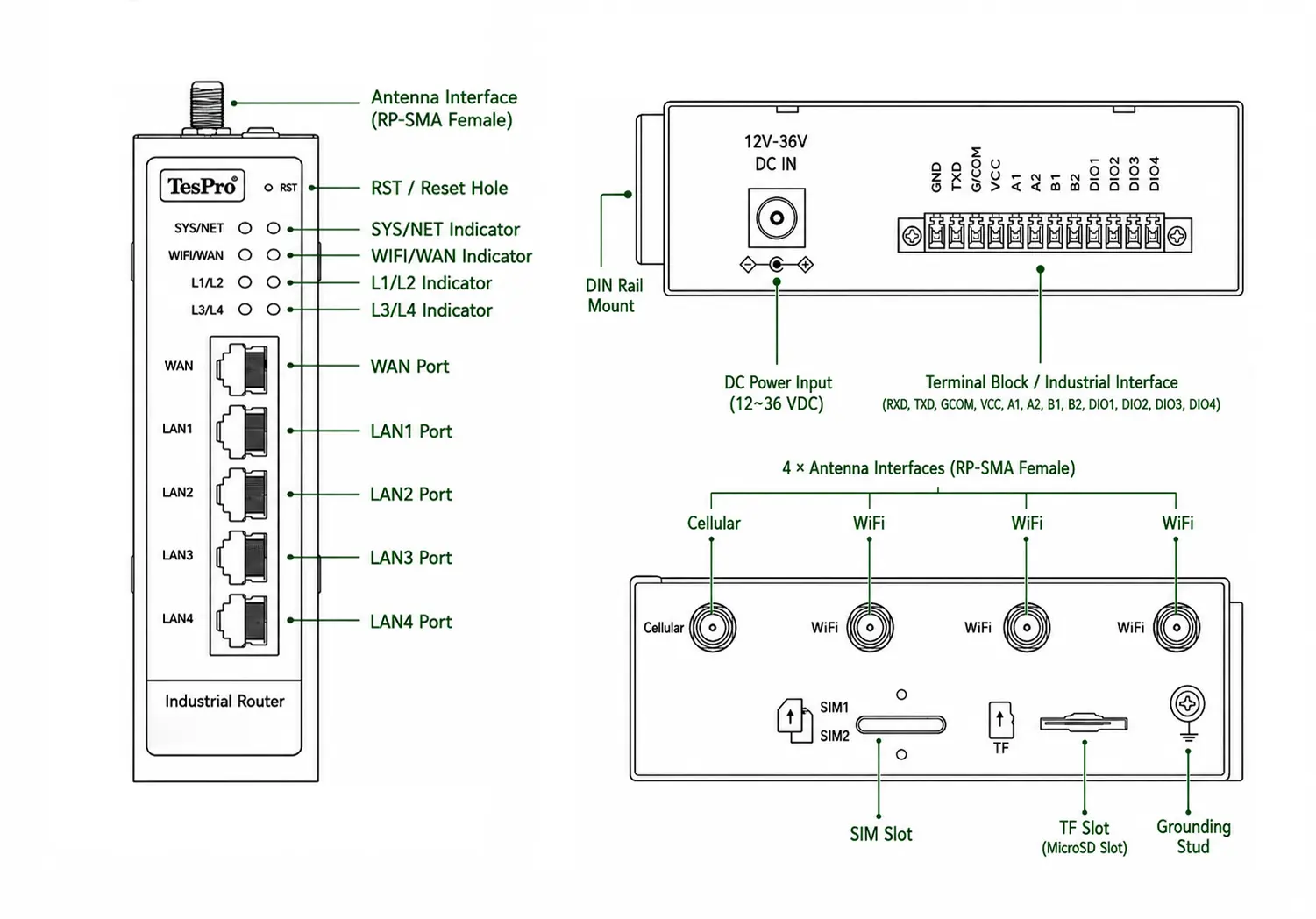
Abmessungsdiagramm
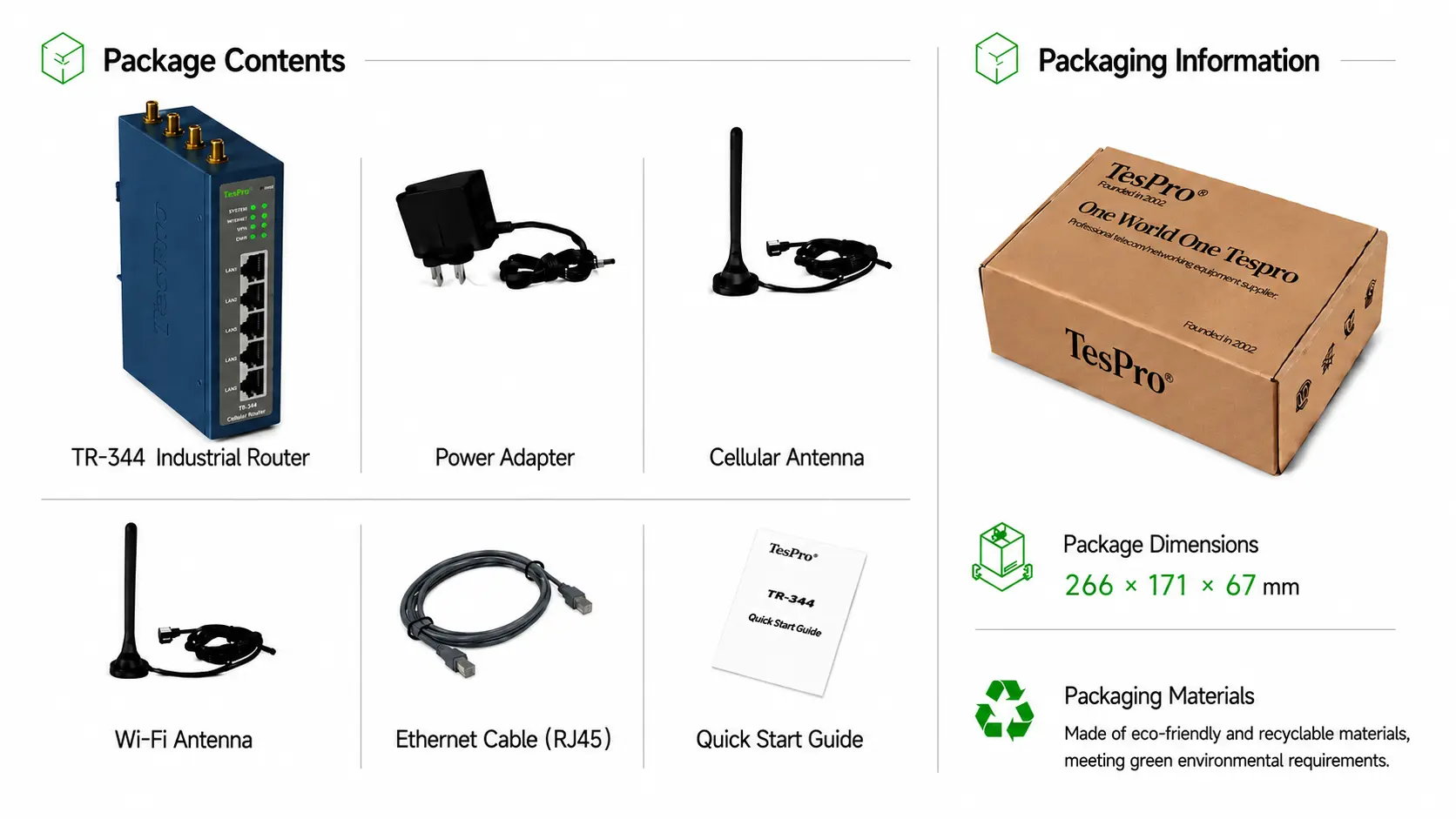
Zubehördiagramm
Explore our Solutions
Lösungen für industrielle Konnektivität und Netzwerke
Bereitstellung robuster Mobilfunk- und Ethernet-Netzwerklösungen, die für eine zuverlässige Datenübertragung in vielfältigen industriellen Szenarien entwickelt wurden
Download Materials
Häufig gestellte Fragen
Um Ihnen zu helfen, die Leistung, Kompatibilität und Nutzung unserer Produkte besser zu verstehen, haben wir Antworten auf häufig gestellte Fragen zusammengestellt. Wenn Ihre Anfrage unten nicht aufgeführt ist, können Sie uns gerne direkt für weitere Unterstützung kontaktieren.
Kontaktieren Sie uns
-
What network and communication methods do TR300-Class industrial routers support?

-
The core value of this series is connecting field devices to carrier cellular networks while providing local Ethernet and Wi-Fi connectivity. Using representative models from the official website as examples, TR-324 corresponds to 4G LTE and TR-325 to 5G LTE; the product-series catalog also covers different cellular generations. For multinational projects, support for local 2G/3G fallback, specific LTE/5G bands, carrier certification, and APN configuration should be confirmed in writing by sales according to the target country and module version.
1. Cellular network: TR-324 is designed for 4G LTE, while TR-325 is designed for 5G LTE. If a project requires multi-mode fallback or specific frequency bands, the target region, carrier, and module configuration must be verified.
2. Wi-Fi: The representative model pages list IEEE 802.11 a/b/g/n/ac and cover the 2.4 GHz and 5 GHz bands. Dual-band Wi-Fi can be used for nearby maintenance, local terminal access, or as a backup link; actual throughput varies with the chipset, channel bandwidth, environment, and model.
3. Wired Ethernet: Gigabit LAN is suitable for connecting PLCs, industrial switches, cameras, HMIs, edge devices, or local maintenance PCs to the same network.
4. Redundancy concept: Representative model pages mention dual-SIM standby and backup switching among wired, Wi-Fi, and cellular links. Dual SIM does not mean every model supports eSIM or automatic dual-carrier strategies; projects must confirm the SIM slots, switching policy, and service plan.
-
What interfaces do TR300-Class industrial routers provide, and how are field devices connected?
-
Representative models typically combine “cellular uplink + Gigabit Ethernet + industrial serial ports.” For devices such as energy meters, PLCs, variable-frequency drives, and environmental sensors, Ethernet, RS485, or RS232 can be selected according to the device interface. Routers are better suited to providing connectivity, forwarding, remote maintenance, and local network management; complex protocol acquisition/conversion requirements can be addressed together with an industrial gateway or protocol converter.
1. Ethernet ports: The top sections of the TR-324/325 pages both list a 2×LAN Gigabit configuration; the specification sections also contain descriptions of LAN0 supporting WAN/LAN auto-adaptation and three Gigabit LAN ports. The inquiry should therefore clearly specify “WAN/LAN quantity, Gigabit/100 Mbps, and whether switching is supported.”
2. Serial ports: The pages confirm RS485- and RS232-type interfaces for common industrial field devices. The exact port quantities are not presented consistently, so the BOM should explicitly lock down the number of RS485/RS232 ports, terminal definitions, isolation requirements, and termination-resistor requirements.
3. SIM and antennas: Representative model pages list dual-layer SIM slots and SMA antenna connectors. The quantity and gain of cellular and Wi-Fi antennas should be confirmed together with site coverage, cabinet installation, and lightning-protection requirements.
4. Power and installation: Representative models are rated for DC 12–36 V and include DC power input, reset, and status indication. The product introduction also describes DIN-rail mounting for deployment inside control cabinets.
-
What are the key technical advantages of TR300-Class industrial routers?
-
The advantage of TR300-Class routers is not simply “Internet access,” but the combination of cellular WAN connectivity, field-device access, network redundancy, and industrial environmental adaptability in an engineering-ready connection node. The following six points are suitable for websites, proposals, or customer inquiry responses, but the product-selection note “confirm by model” should be retained.
1. Multi-mode cellular access: 4G or 5G models meet different bandwidth and latency requirements, while dual-SIM and multi-network redundancy can be confirmed on a project basis.
2. Gigabit local networking: Representative models provide Gigabit Ethernet for industrial switches, edge terminals, and local maintenance networks.
3. Industrial serial connectivity: RS485/RS232 helps connect legacy PLCs, meters, controllers, and smart meters, reducing the need for additional interface converters.
4. Remote network operation and maintenance: The router section of the official website mentions VPN support and remote management. The VPN types actually available, account permissions, remote upgrade functions, and platform capabilities must be confirmed according to the software version, project architecture, and security policy.
5. Link-continuity design: Representative pages mention dual-SIM standby and backup switching among cellular, Wi-Fi, and wired links to reduce the impact of a single unavailable network on data backhaul.
6. Adaptability to harsh environments: The TR-324/325 pages list operation from -40°C to +75°C, 5%–95% non-condensing humidity, and wide-voltage DC 12–36 V, making them suitable for industrial cabinets, protected outdoor enclosures, and utility facilities. For high-altitude, high-humidity, high-salt-fog, or high-voltage environments, product certification and enclosure-system design must be confirmed separately.
-
What are the main application scenarios for TR300-Class industrial routers?
-
This series is particularly suitable for projects where “devices are distributed, on-site service is costly, and stable wide-area network backhaul is required.” The following six categories are typical directions; actual solutions should first complete signal testing, network-security design, power-supply evaluation, and protocol integration testing.
1. Industrial automation: Connect PLCs, HMIs, variable-frequency drives, or production-line control networks to enable status viewing, remote maintenance, and cross-site data backhaul.
2. Smart buildings: Connect building controllers, energy meters, HVAC plant rooms, or BMS subnets to upper-level platforms.
3. Outdoor environmental monitoring: Provide cellular backhaul for weather, dust, water-quality, and station sensors; waterproof enclosures, surge protection, and antenna solutions are also required.
4. Intelligent transportation: Used for distributed network nodes such as roadside equipment, parking systems, bus stops, and traffic monitoring.
5. Smart energy and power: Connect electricity meters, distribution monitoring devices, PV inverters, or energy-storage subsystems and transmit data to a central platform.
6. Smart robots and mobile equipment: Provide cellular network access for mobile or remote equipment in warehouses, campuses, construction machinery, and similar scenarios; bandwidth, roaming, coverage, and security policies must be validated on site.
-
Which protocols and systems are TR300-Class industrial routers suitable for?
-
Representative model pages list multiple power-metering and industrial protocols, including DL/T 645-2007, IEC 62056-21, IEC 1107, IEC 61850, DLMS, as well as Modbus RTU, Modbus TCP, BACnet, M-Bus, and OPC UA. Note that the router’s fundamental role is network transmission and remote connectivity. Whether it can “directly parse, acquire, or convert” a specific protocol also depends on the purchased model’s software functions, the peer device, mapping rules, and the project integration method.
1. When an existing host computer, edge gateway, or platform performs protocol parsing, the router can provide stable cellular backhaul and local network access.
2. When multi-device acquisition, offline caching, edge logic, and large-scale protocol adaptation are required, prioritize evaluation of the TG series industrial gateways.
3. When explicit data mapping between BACnet and Modbus, or OPC UA and Modbus, is required, prioritize evaluation of the TC-100 protocol converter.
4. Before purchasing, provide the device protocol manual, point list, baud rate/parity settings, network topology, security requirements, and target-platform interface so that feasibility can be confirmed.
-
How are warranty, pricing, and purchasing handled for TR300-Class industrial routers?
-
The official product pages provide “Request a Quote” and sales contact options, but do not publish a uniform standard warranty period, retail prices for all SKUs, or extended-warranty terms. Therefore, external publications should state that details are “subject to the written sales quotation, order, and contract,” and should avoid presenting an unpublished one-year warranty or 2–5-year extended warranty as an established commitment.
1. Warranty and extended warranty: It is recommended to provide sales with the model, quantity, deployment country, project environment, service-response requirements, and spare-parts requirements, and request written quotations for the standard warranty, 2–5-year extended warranty, or project services.
2. Pricing and samples: Small-quantity samples can be viewed through the Tespro Online Shop; bulk purchases, OEM/ODM, specific frequency bands, custom protocols, or project packages should be formally quoted by sales.
3. Contact sales: The sales quotation email is sales@tespro.com; the general inquiry email is info@tespro.com. The official website lists telephone/WhatsApp numbers +852 4609 4648 and +1-213 610 4797.
4. Learn more: Products, cases, and demonstrations can be viewed through Tespro’s official Facebook, LinkedIn, YouTube, TikTok, X, and Instagram accounts. The official datasheet and written response should be treated as the final technical reference.
5. Inquiry recommendation: Including the model, country/carrier, quantity, network bands, SIM plan, interfaces, protocols, temperature/humidity and enclosure requirements, lightning protection, certification, lead time, and after-sales requirements in the email can significantly improve product-selection and quotation efficiency.

